Guest Edited Journal Issues
South Asia Multidisciplinary Academic Journal (SAMAJ), 20: 2019

Sedition, Sexuality, Gender, and Gender Identity in South Asia
While there is a consensus that we are in a period of heightened official foreclosure of critical speech in South Asia, it would be wrong to presume that this historical period is exceptional in this regard. This special issue of SAMAJ takes up the ways in which laws against sedition and other laws controlling speech in South Asia are being used by the governments there with increasing frequency—against activists, lawyers and journalists. The issue is an examination of the uses of judicial and extrajudicial means to silence dissent throughout South Asia, and with an eye toward the historical precedents of particular contemporary instantiations of foreclosing and repressing critical speech.
Here, we put these attempts at foreclosing criticism of the state in dialogue with the rise of new forms of public discourse and debate on gender and sexuality in South Asia, in order to pose a series of questions. What do questions of sexuality and gender identity have to do with revolutionary politics, with questions of class and political economy? Where are the spaces for radical critique constituted when there seems to be more space for different forms of gender and sexuality politics, sociality, and critique, and when the stakes of dissent seem to be climbing ever higher? Does it mean something in particular to have a queer feminist analysis, or to be queer or trans, in such times? Amongst these articles, the short answer to the last question is yes, but these meanings are multiple, and the grounds on which the politics of sexuality and gender rest are highly contested.
Drawing on the longstanding history of feminist engagements with—and reliance on—the notion of dissent, and on work that interrogates the intersections of gender identity, sexuality and national belonging, this collection seeks to examine dissent, nationalism, and the politics of gender and sexuality within the frame of contemporary South Asia.
Anti Trafficking Review
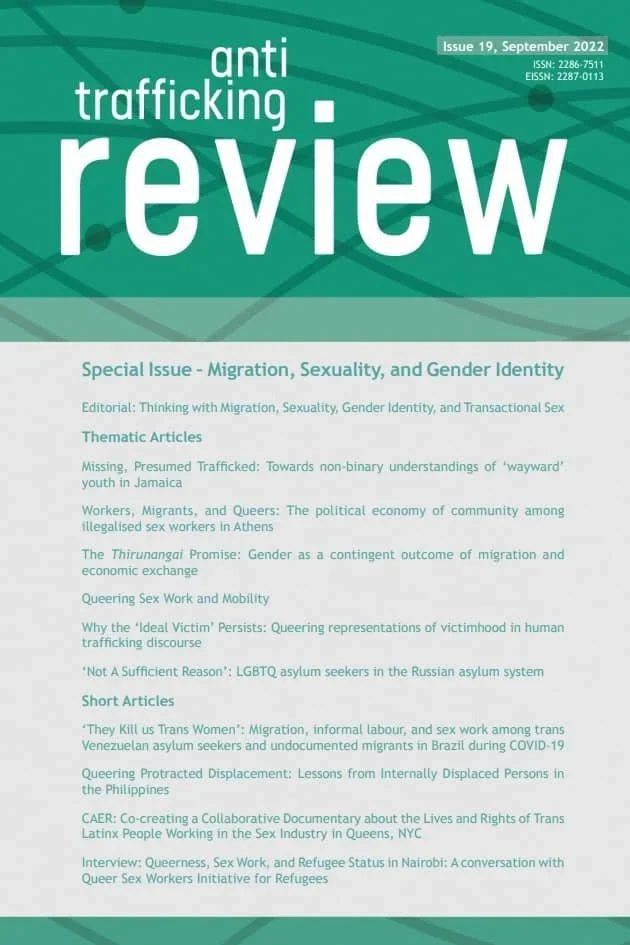
No. 19 (2022): Special Issue – Migration, Sexuality, and Gender Identity
Over the past decade, there has been growing recognition of LGBTI+ people’s specific experiences with migration, asylum, informal labour, exploitation, and community-building away from home.
This Special Issue of Anti-Trafficking Review contributes to this literature with new conceptual and empirical research from countries across Asia, Europe, Africa, and the Americas. In highlighting the fluidity of sexuality and gender identity, the issue also expands our understanding of how survival is waged in the worlds of migration and informal labour.